July 31st, 2011

Christmas in Malta

Christmas or ‘Il-Milied’ is one of the most popular feasts in the Maltese islands. A lot of its popularity derives from the longstanding Catholic tradition embraced by most.


The Crib or ‘Presepju’ depicting the nativity scene is one of the festive highlights. Churches have their crib but many people like to set up their own and display it behind the house window. Exhibitions featuring different kinds of cribs are also organised. The live Christmas village has also garnered popularity. Life at the time when Jesus was born is re-enacted and people take on the different roles to bring the village to life.


Midnight Mass is also a favourite. This special Mass features ‘the child’s sermon’ or ‘il-priedka tat-tifel’ as it is the child that delivers the sermon not the priest. The child is usually 7-10 years old and is known to start preparing for it from weeks before. Many learn it by heart and are anxious to deliver it well.


Christmas decorations are also widely seen in almost every public place, institutions, as well as private houses. At night, Christmas trees and other lights can be seen behind balcony doors and main windows. Church facades are also lit up as are main streets and shopping areas. Shops do their best to similarly dress up their windows to attract customers. During December, shops open up even on Sundays and public holidays for Christmas shopping.


It has become popular for hotels and catering establishments to organise Christmas breakfasts. People go to these breakfasts after Midnight Mass or after having spent the night out. Many Maltese however still prefer to spend Christmas with their friends and families at home.


The treacle ring or ‘qaghaq tal-ghasel’ as well as the Chestnut and Cocoa Soup or ‘Imbuljuta tal-Qastan’ are typical Maltese Christmas desserts. Yet, one can also find Christmas cakes, Christmas logs, mince pies and Panettone on the Maltese table as our cuisine has been greatly influenced by British and Italian cuisines.


What has almost become a new Christmas tradition is l-Istrina. This is a live televised program broadcast on Boxing Day with the aim of collecting funds for the Malta Community Chest Fund. Chaired by the President of Malta, this charitable institution aims to offer support to various philanthropic organisations. During this program, people can donate money showing the true Christmas spirit and giving millions to those in need.

VN:F [1.9.10_1130]
Rating: 0.0/10 (0 votes cast)
VN:F [1.9.10_1130]
Rating: 0 (from 0 votes)
July 31st, 2011

Christmas Crafts

For people who love adding their personal touch to gifts and decorations, Christmas provides the perfect opportunity to put all creative juices to play!


There are many Christmas crafts – from the most simple to the quite elaborate. The various craft shops and online resources have made it much easier to try your hand at these crafts. It is also a good way how to get children involved. There are many crafts specifically aimed at children. Even if it’s not aimed at kids, under adult supervision, they can help with getting the creations ready and seeing something created from scratch.


However, as with all crafts, time is what is first and foremost required. Even the most simple need time and patience. Unfortunately, with the ready available decorations, few turn to crafts as they feel it is not worth the time and effort if it can be easily – and sometimes cheaply – bought.


Yet, for those who prefer doing things themselves, here are a few ideas that can be easily done. A wealth of information can be found online as to how to go about doing them. In the meantime, this can be enough to kick-start some Christmassy inspiration…


Gift-Wrapping
Gift-wrapping doesn’t have to be just a nice paper wrapped around a gift. Ribbons, fabrics, punched snowflakes, tissue paper, bells and strings can all be used to embellish that wrapping. Martha Stewart thought of 46 gift-wrapping ideas so there’s no limit to one’s imagination.


Gift tags and labels
Presents can be personalised by adding a handmade gift tag. The shape of a Christmas sock or tree can be easily taken from clip art libraries and then cut out of bright thick paper. Add to that ribbons or stickers and that gift tag can be made truly unique.


Handmade ornaments
From tree decorations to stand alone ornaments, there’s a lot that can be done if you get the right materials from craft shops. Stand-up snowmen can be made out of simple materials such as plastic foam balls, glitter, felt, glue and soda caps amongst others things one finds around the house.


The above aren’t even the tip of the iceberg. Just spending some time going through craft books or browsing the web can be pretty revealing. So, next time you’re at a Christmas shop think twice before buying as you might have more fun doing it yourself!

VN:F [1.9.10_1130]
Rating: 10.0/10 (1 vote cast)
VN:F [1.9.10_1130]
Rating: 0 (from 0 votes)
July 14th, 2011

History of the Maltese Crib

It was St Francis of Assisi who introduced the custom of having a crib for Christmas back in 1223. However, it was only in 1617 that the first crib was built on the island of Malta and exhibited by the Dominican Friars in their church in Rabat.


At the time, only the rich and noble could afford to have cribs. Heavily influenced by the Neapolitan style, these cribs featured statuettes made from wax or ivory, dressed in rich textiles. The cribs also featured intricate landscapes. Various rich people brought these statuettes to Malta, however they weren’t well received by the local people. The expensive figurines were a far call from the poverty in which Jesus was born.


The Maltese identified more with the Sicilian style of crib making probably because Sicily’s landscape was very close to that of Malta. They took inspiration from local trades, costumes and buildings so that their crib represented the Maltese way of life.


In the beginning, most cribs were made out of rustic stone and coal residues. However, these two elements were then replaced by papier-mâché. The latter made cribs more solid and lightweight. However, it also meant that cribs couldn’t be as easily dismantled as before and this storage problem meant that most cribs were often destroyed after the festivities.


There was a change even in the statuettes or ‘pasturi’ used in cribs. Expensive figurines gave way to statuettes made out of clay with their faces, hands and clothes painted on. Later, these statuettes were replaced by figurines made out of plaster moulds sold at a penny each.


Way into the mid-1900s, making cribs started to lose its appeal as more importance was given to decorations such as the Christmas Tree and other easy to mount decorations. All the work involved in creating and setting up a crib put off people and those who really wanted a crib started to look for ready-made mass produced ones.


There are still people who are fond of old traditions and year after year set up exhibitions in which various hand-made cribs are displayed to the general public. It is these enthusiasts and groups like ‘The Friends of the Crib Society’ that keep cribs alive today!

VN:F [1.9.10_1130]
Rating: 0.0/10 (0 votes cast)
VN:F [1.9.10_1130]
Rating: 0 (from 0 votes)
July 9th, 2011

The Christmas Crib

Mary, Joseph and a baby in a manger – these three figures make up the core of the Christmas Crib. Also referred to as a nativity scene or crèche, the crib portrays the birth of baby Jesus. Other characters such as shepherds, the Magi, angels and animals are also featured.

Come Christmas time, many houses, churches and shopping malls feature a crib. However this custom started almost a thousand years ago. St Francis of Assisi is regarded as the person who set up the first crib way back in 1223. At the time, he was concerned the feast was becoming too materialistic so he wanted to remind people of the true meaning of Christmas: God, out of his immense love, sent his only son to the world to be born in poverty.

St Francis of Assisi wanted to recreate that magical night so he found people, a stable with animals and straw and created the first ‘live’ crib. The tradition spread from Italy to the rest of the Christian world.
Between the 16th to the 18th centuries, cribs – especially static cribs – became quite elaborate works of art. Some featured wax or ivory figurines dressed in very rich fabrics set against intricate scenes. These expensive cribs were very popular in Naples. In other parts of the world however people focused on creating a more realistic portrayal of the birth of Jesus.

Both live and static cribs are still popular to this day. There are many people who create their own crib out of wood and paper. In some countries, cribs are given a more ‘local’ feel so that they resonate more with the people. For instance in Colombia, Mary and Joseph wear ponchos and country clothes and characters are depicted as Colombian natives. In some European countries, figures have Western features.

In some live cribs, it’s not only the nativity scene that is recreated but the village of Bethlehem! There are horse-drawn mills, shepherds inhabiting caves, animals in barns and actors showing folkloristic trades. Underneath the moonlight, by the light radiating from fires and torches, visitors are taken back in time and can just imagine what it could have been like on that silent night.

VN:F [1.9.10_1130]
Rating: 0.0/10 (0 votes cast)
VN:F [1.9.10_1130]
Rating: 0 (from 0 votes)
June 26th, 2011

Christmas Decorations

In the past, Christmas decorations were put up on Christmas Eve. Nowadays, there’s hardly anyone that waits that long to start dressing up the house.

Although the Christmas tree is one of the most loved and universally recognised symbols, there are various other decorations that have earned their place in our households. The religious icon of Baby Jesus is one of them. Either as part of the nativity crib or set as a figurine on its own decorated with fairy lights and canary seed, this icon features greatly in most Christian places. On the other hand, the crib, ranging from the home made to the life-size, can be found on window sills or embellishing halls. The star of Bethlehem is also widely noticeable during this month. The Star typically adorns Christmas tree tops or window panes. You can find it as part of fairy light sets or as window stickers. Businesses have found countless ways into which such icons can be turned into sales.

There are various other non-religious icons that by time have become just as popular as their religious counterparts. A case in point is Santa Claus or ‘Father Christmas’. You can see him on cards, as a figurine, cushion, sticker, soft toy and even as a scented candle! Similarly bells, snowflakes, snowmen, icicles, robins and penguins in all forms and sizes have become decorations. For this period, some people even use festive dinner sets, salt and pepper Santa Claus and Christmassy table cloths and furnishings.

Many people decorate using the traditional Christmas colours which are pine green, white and red. However, through the years metallic colours such as gold and silver have also gained popularity. Decorations are made from coloured paper, foil, even ceramic. Some hang in hallways, others adorn shelves. There are garlands hanging on front doors and lights decorating balconies, porches and windows. Plants such as the poinsettia, holly, red berries and mistletoe are also used as decorations.

Whatever the decorating style, you can’t help but feel the anticipation to the holiday season building up the minute the first fairy light is switched on…

VN:F [1.9.10_1130]
Rating: 0.0/10 (0 votes cast)
VN:F [1.9.10_1130]
Rating: 0 (from 0 votes)
June 19th, 2011

Decorating the Christmas Tree

One of the most popular festive decorations is certainly the Christmas tree. Be it real or artificial, it is usually the biggest ornament and gets by far the most attention.


In the 1600s, Christmas trees were decorated with apples, nuts, dates, pretzels and paper flowers. Over time, candles were added to light it up. It also became customary to add sugar ornaments such as candy canes. On the other hand, the Russians had a very particular way of decorating the tree. Banned after the October Revolution, the Christmas tree was re-instated as a symbol of the New Year rather than Christmas. For them, the star on top of the tree became symbolic of the Red Star and not the Bethlehem Star. They decorated it with various figurines of airplanes, bicycles, space rockets, astronauts and characters from Russian fairy tales. After the fall of the USSR this custom was kept and to date the New Year still outweighs Christmas in popularity.


Nowadays, the most common decorations for the tree are baubles, tinsel, garlands and ribbons as well as small Christmassy figurines like angels, snowmen, robins, etc. Fairy lights – be they either in one colour or mixed up with coloured lights to brighten it up – also play a central role in the decorations.


However, rather than selecting ornaments and decorations ad hoc, one can get more creative and select a colour theme for the tree. For instance, if the colour red is chosen, decorations can be selected accordingly. Red baubles, red garlands and tinsel. One can then add velvet or satin ribbons and flowers to add texture. Sometimes, red is paired with gold to make the tree look more elegant. An angel or Bethlehem star is usually selected as a tree topper. This too can be selected according to the theme chosen.


A tree skirt to hide the Christmas tree stand is the final touch. Some skirts are quite smart with embroidery trimmings. Others can sport a brightly printed nativity scene or any other Christmas-related picture.


When everything is done, all that is left is for presents to be placed underneath the tree!

VN:F [1.9.10_1130]
Rating: 0.0/10 (0 votes cast)
VN:F [1.9.10_1130]
Rating: 0 (from 0 votes)
June 12th, 2011

The Christmas Tree

A Christmas custom is born!


Be it real or artificial; traditional, fancy or LED; the Christmas tree has become part and parcel of the Christmas tradition. During the festive season it can be seen everywhere – adorning houses, front yards, squares and shopping plazas. Although it now garners a lot of attention, the Christmas tree has far more humble beginnings…


Historically, the origins of the Christmas tree can be traced as far back as the 15th century. In what is now called Tallinn in Estonia, a tree was erected by the Brotherhood of Blackheads in their house. As the festive celebrations were coming to an end, the tree was taken to the Town Hall Square and brotherhood members danced around it. The Guilds took on this custom and there are recorded instances where a tree was decorated and put outside guild halls during Christmas to be enjoyed by members and their families.


During the early years of the 18th century, the towns of upper Rhineland were the first areas which made the setting up of this Christmas tree a custom. At first, Roman Catholics viewed it as a Protestant tradition. However, as this custom continued to spread, they realised they couldn’t stop its adoption by members of the community and hence accepted it.


In the 19th century, it had become popular amongst nobility and was introduced in royal courts. The Christmas tree started popping up in various countries across the globe – Canada, Austria, France, Denmark, Britain and even Russia. It made its first appearance in print thanks to Hans Christian Andersen. In his fairy-tale The Fir Tree, Andersen told the story of a fir-tree who was transformed into a Christmas tree. In America, it started to gain popularity after an illustration was printed in Godey’s Lady’s Book in the mid 1800’s. Godey’s copied their illustration from the one appearing in the Illustrated London News in 1848 depicting the British Royal family around their Christmas tree at their Windsor Castle.


By the 20th century, the Christmas tree started taking centre stage in most countries. There has never been a set date as to when the Christmas tree should be set up. Early on, people used to erect it just before Christmas. Nowadays, it is set up as early as the beginning of December. Regardless of the date, the Christmas tree is surely set to make its grand appearance during the festive season.

VN:F [1.9.10_1130]
Rating: 0.0/10 (0 votes cast)
VN:F [1.9.10_1130]
Rating: 0 (from 0 votes)
July 23rd, 2010

The Nightmare before Christmas

The Nightmare Before ChristmasIt is the same routine every year in Halloweentown, on Halloween the monsters come out and perform a real scare. This particular Halloween, the pumpkin king Jack Skellington, bored of the idea, saunters off into the woods with his dog Zero after Halloween night. Upon the break of dawn, he discovers a clearing of trees with different doors representing various holidays. The Christmas Tree door attracts his attention and upon entrance into the world of Christmas, Jack is fascinated with this new idea of Christmas that he must absolutely share with the citizens of Halloweentown. This movie milestone from Tim Burton is a fun fantasy for the whole family!

VN:F [1.9.10_1130]
Rating: 9.0/10 (2 votes cast)
July 23rd, 2010

Elf

ElfBuddy was a baby in an orphanage who stowed away in Santa’s sack and ended up at the North Pole. Later, as an adult human who happened to be raised by elves, Santa allows him to go to New York City to find his birth father, Walter Hobbs. Hobbs, on Santa’s naughty list for being a heartless jerk, had no idea that Buddy was even born. Buddy, meanwhile, experiences the delights of New York City (and human culture) as only an elf can. When Walter’s relationship with Buddy interferes with his job, he is forced to reevaluate his priorities.

This is a great family movie!

VN:F [1.9.10_1130]
Rating: 10.0/10 (2 votes cast)
July 23rd, 2010

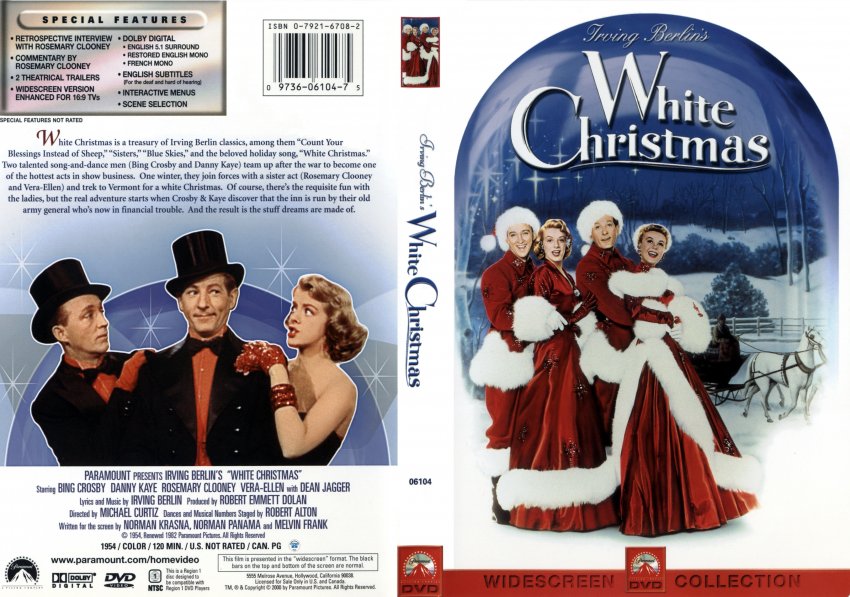
White Christmas

White ChristmasWhite Christmas is a treasury of Irving Berlin classics, among them ‘Count Your Blessings Instead of Sheep’, ‘Sisters’, ‘Blue Skies’, and the beloved holiday song, ‘White Christmas.’ Two talented song-and-dance men (Bing Crosby and Danny Kaye) team up after the war to become one of the hottest acts in show business. One winter, they join forces with a sister act (Rosemary Clooney and Veraen) and trek to Vermont for a white Christmas. Of course, there’s the requisite fun with the ladies, but the real adventure starts when Crosby & Kaye discover that the inn is run by their old army general who’s now in financial trouble. And the result is the stuff dreams are made of.

VN:F [1.9.10_1130]
Rating: 10.0/10 (1 vote cast)